~Ah, Terry Pratchett. How I love thy books~
Terry Pratchett had to be one of my favourite writers of all time, though I only started reading him long after his death in 2014. His approach to characters and fantasy was altogether unorthodox – I’ve never seen such an intimate, funny setting in all my life! Of course, it took him a while to reach his prime. The first 5 or so books aren’t quite consistent – and his last four books (Excluding shepherd’s crown) were certainly growing rusty – but every one of them was certainly fun: an absolute triumph for a forty-one book series!
Alright, I’ve gushed enough for now. You can see I’ve got a blatant bias towards today’s subject.
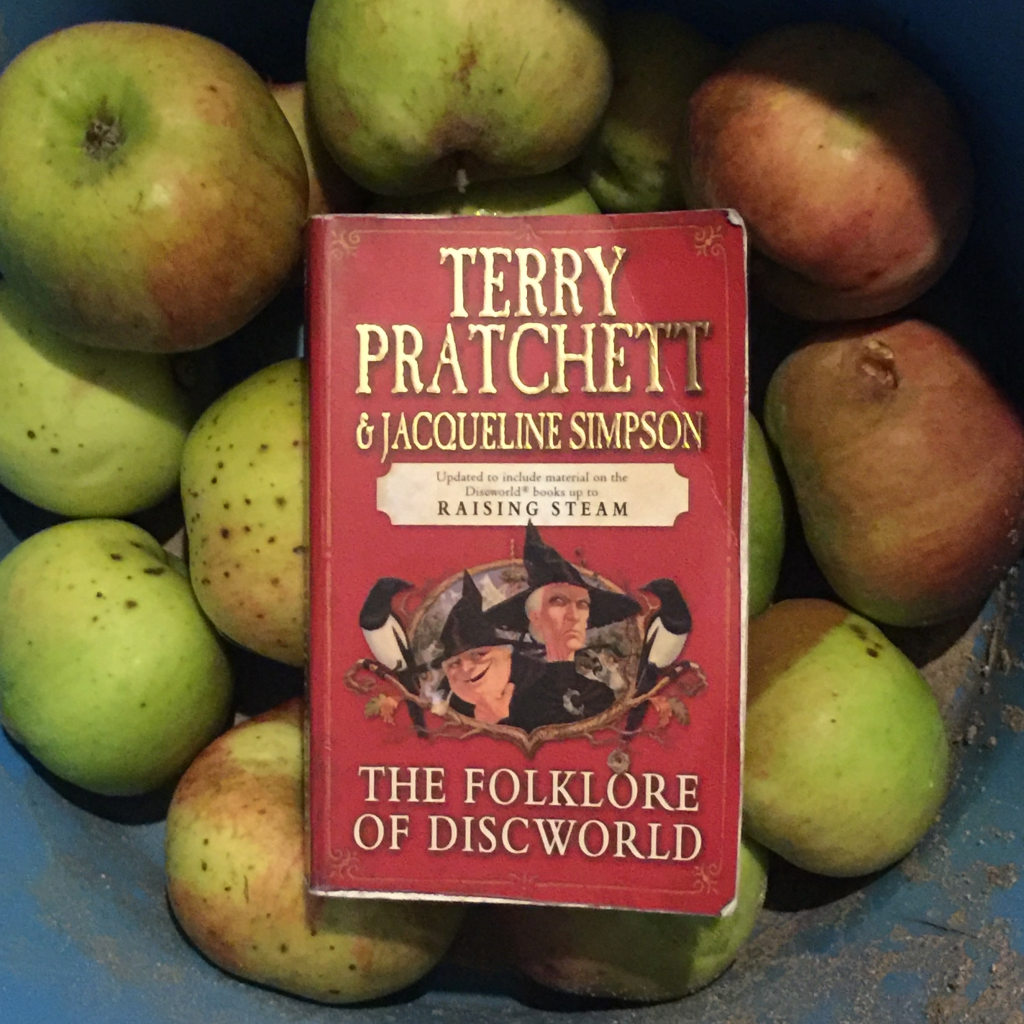
But just how did Terry Pratchett construct this iconic setting, perched atop four elephants and a turtle? Where, too, did the twisted glamour of the incursive elves originate? The vanishing city of Leshp? The trundling maniac Luggage? The absurdly complex culture of dwarves?
Why, he appropriately nabbed a page from Picasso (who I don’t like so much) – Terry stole these ideas from all over the world! A grand heist of inspirations familiar and clandestine! With the exceptional scrutiny of folklorist Jacqueline Simpson to help him recall, Pratchett produced this chunky testimony to his creative plagiarism.
The review – Maypole mania.
Unlike Nanny Ogg’s cookbook or any of his other spinoffs, the author duo have deliberately chosen a much more meta analysis of their setting rather than an in-universe spin. That’s not to say it’s technical and stuffy – oh, far from it! For each Roundworld (that is, Earth) archetype they investigate, there follows plenty of banter, call-backs to iconic incidents within the novel series and the odd anecdote about Terry – including a lost ring, a dancing rock and a woman with a huge suitcase. All this is told with deadpan severity, with hardly an exclamation mark in the main body, which only makes it more of a chortle. For record, 6 passages made my laugh out loud, especially the discussion of edgy victorian claims about the King of the Bean tradition – the same sort of reactionaries who turned Maypoles into a lewd icon!
With a bibliography of over thirty books under their belt, the book covers a very diverse range of myth and hearsay from all over Europe and beyond. Many inspirations are very mainstream today, such as the tolkienian origin of dwarves, the borrowed beasts of greek lore and a handful of lovecraft jabs from the early days – stuff anyone might recognise. It is wary,though, of how repeated retelling has dulled the sheen of these once enthralling narratives, so doesn’t faff around there too much. The books real devotion is to the lesser known customs and tales – things I’m surprised Terry is aware of.
I shan’t spoil too much – we don’t want a repeat of little Nell last week. The book, to use a seasonal example, takes an in depth look at the perception of one of Discworld’s most integral occupations – witchcraft – going much beyond the knowledge of the average pagan…in fact, it identifies the possible misconceptions ABOUT witches that led to the pagan belief developing. Going beyond the typical references to shakespeare and Matthew Hopkins, it buries deep into many famous wisewomen (and cunning men) such as the irish herbalist Biddy Early and the prophet Mother Shipton, referring to contemporary sources about them. For the more bloodthirsty too, there are plenty of stories about maligned maniacs from the satanic communities and black academies mixed in too – Black Alice is a particularly ferocious ghoul studied within! For each study, it draws on the parallels with the Discworld coven, particularly Granny Weatherwax, and how their customs mimic the round world ways. In fact, tongue lodged far up the cheek and into the nose, Jacqueline simpson even talks about how some of the practises and beasties from Discworld might have slipped over the edge of reality to influence our history! keeping the continuity with the science of Discworld spinoff, eh?
The detail is exquisite – Simpson takes time to not only sniff out Terry’s inspirations, but also record the very folk history of that inspiration. She tracks down the origins of the ever evolving western depiction of death; he wasn’t always a bleached skeleton, didn’t always have a scythe and often isn’t even a he. Every subtle reference to folk knowledge is scruitinised – a festive ponderance of the reaper’s assistant Albert Malich yields five different obscure Hogswatch-er, “christmas” customs which are lovingly explained. Nearly the whole 40+ book series is dredged up for inspection, demonstrating just how broadly the cultural element of worldbuilding can be derived. If he were to be charged for his creative theft, poor Terry would wrack up a criminal record over a hundred pages! He’d never get bail at that rate.
Trying to find shortcomings – Still thirsty when the waiter is dead.
Of course, Terry didn’t actually introduce any “new” insights to the disc – all the subjects of discussion are drawn from his previous works. Thus, there are many elements of the world still compariatively underdeveloped and undervisited in this book that sadly will never be completed. He had lumped a lot of the minor sentient species into a chapter of their own and talked about their origins, but we don’t hear much of their culture beyond the slight that is already said in the stories. This, of course, wasn’t Terry’s fault really – he did remarkably well to battle alzheimers long enough to introduce the new characters, creatures and countries that he did. This feeling of disatissfaction this says a lot about what I think about the book – it’s so excellent, so inspiring that I can’t get enough of it even as the writer is long gone. It’s stuff like this that makes me want to write my own fiction…exempting monday’s episode of writing block, of course.
As a bloody incompetent book reviewer, I’m again struggling to find any shortcomings for this book, the above disatissfaction withstanding. I’d personally like to have heard more a bit more evaluation from terry. It’s hard to tell how much of the choices of folklore references were deliberate or rather by coincidence – Did Terry Really have a purgatorial Scottish Ballad and/or the brutal Lyke Wake dirge in mind when he wrote the menacing gnarly ground from Carpe jugulum or was that a coincidence? It makes for an interesting narrative to draw the comparisons, sure, and we’re all the wiser for having heard about such a slab of highland/dale poetry, but it doesn’t really tell us much about what’s going on in Terry’s sconce when he was writing it. Admittedly, that is more of a thing for Terry’s biography, which I happen to have read(Rob Wilkins’ A life with Footnotes), but still I’m left hanging in that respect. Maybe some secrets are better off unknown – if the resolution is stupid/boring/both, there will be no excuse to look at all this lovely lore.
Conclusion – Learn the lore, beat the bore.
Thus book has been thus a remarkably helpful and engaging guide for worldbuilding. It shows how one great writer had (or claims to have) taken so many stories he’d heard in life and turned them into something fresh – for though a lot of the elements of pratchett’s world is unoriginal, it is recast in a way that is sharper and funnier than the source. As he himself said – “Most modern fantasy rearranges the furniture in Tolkien’s Attic”, while Terry here has imported some antiques from Rome, borrowed Wodehouse’s coffee table,bought Douglas Adam’s towel rack and stolen Diann Wynne Jones’ wallpaper.
It is also rather harrowingly a bit of a demonstration to how widely read a writer must be to produce good settings. In his life, Terry has visited so many regions all over the country and inquired extensively about local tradition to help establish his fabricated worlds in vivid quality – the 30+ bibliography at the end a testament of how much work he’d had to do. As someone who doesn’t travel much and could read more, this is sobering. Original ideas can only get you so far – if you want to produce something substantial and yet not too stale, you’re going to need to grab ideas from all over the shop. Still, this is a goal that I may set myself, even if I don’t intend to produce a whoppers fantasy series in my lifetime. The more you learn from reading, the more tricks you can pull off on a microsoft word document.
Good reason to keep up this Book review, eh?
The folklore of discworld is £10.99 on Waterstones. As I type this, I discovered that someone’s tried to sell it for seventy five quid on “Awesomebooks”: talk about scalping! Get it cheap, for pete’s sake.
 Ben Easton - The Novel Hovel
Leave a comment