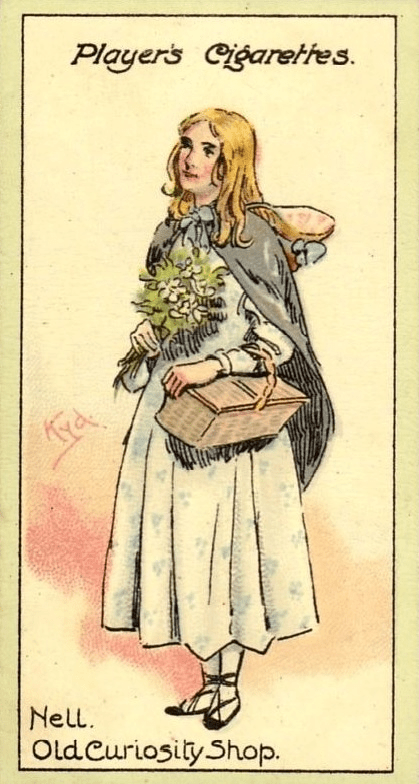
…and then poor Trent gets bent at the en(d)t! yes! A spoiler – wodged at the start of my review! But by now, it’s hardly uncommon knowledge. I first found out about Nellie and her sentimental end from a Horrible Histories book – Vile Victorians, to be precise. The victorian public were absolutely wild about this book – Americans following the serial demanded to know from Brits coming in at the docks whether Dickens had really bumped her off. She quickly became one of Dickens most tragically beloved characters – a perfect innocent who dies from her dilligent efforts to save her only family from wicked avaraice. She was, I dare say, the Icon of 1841.
For a sci-fi writer, I have read a concerning quantity of dickens novels. This is not necessarily an aminous affair – his prose is often overstretched and loaded with corn (not least in Martin Chuzzlewit), but his character designs are absolutely fantastic…when they’re not anti-semitic or somewhat chauvinistic, of course. Besides, compared to a good deal of writer’s from his age, he doesn’t focus as much on the inecessant sociality of the wealthy and he actually works action into his plot.
Instead of writing, though, about his most covered pieces – the secondary school favourite Oliver Twist or the overcited opus Great Expectations – you see I’m focusing on one of his fallen creations. Not many people in this present age can stomach the sheer milksop nature of this novel – even Oscar Wilde found it laughable, according to Marcia Eaton’s findings (1986). Well, if you only read the best and the worst, you won’t be avoiding mediocrity – you must see a balanced piece to produce one! Don’t confuse your wet-wipes for tissues for this, because you might be wiping some tears of laughter away!
The review – How curiosity killed the kid.
To stop this from becoming rambling after that big bacon of an introduction, I’ll keep the story summary brief.
Due to blowing too much on his serious gambling addiction founded on earning inheritance for his grandaughter, Grandpa Trent’s entire property is taken over by the hyperbolically unpleasant Mr Quilp, who wants to pressurise the man into marrying his child when she comes of age – Typical victorian grossout. Nell trent, however, convinces her grandad that resorting to beggary would conserve their dignity far more than submitting, and thus they escape in the night to get as far as they can from the horrible scamster. Cue a rich cast of absurd names, odd quirks and two deathbed scenes. Of course, there are many side plots also. There if the rising of Nell’s Humble associate Kit, who quilp tries to scapegoat for his crimes. There is…Pff…Dick swiveller…
Why’d they relegate the primary romance plot to THIS walking innuendo?
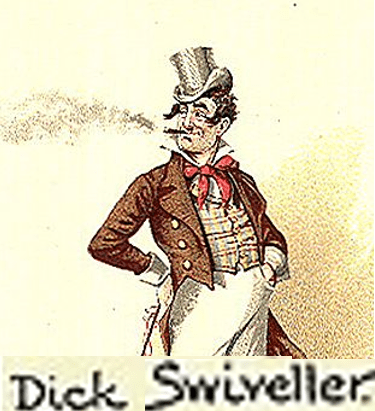
Sorry, excuse my paroxysm. Anyway, Swiveller here helps Kit out after falling for one of the servants of Quilp’s cruel lawyers – the Brass siblings. There is also a seeming outsider who wishes to contact the Trents and the sporadic lech Fred Trent – who wants a piece of Grandpa trents seriously overstated wealth.
I will not spoil how Nellie comes a-cropper or if any other characters join her. I will also avoid spoiling the other side characters bar one who I think is terribly, terribly underrated. Let’s get on with the reviewing.
Reviewing a fifty year old edition of a hundred-and-fifty year old novel like a arrogant tiktok twat.
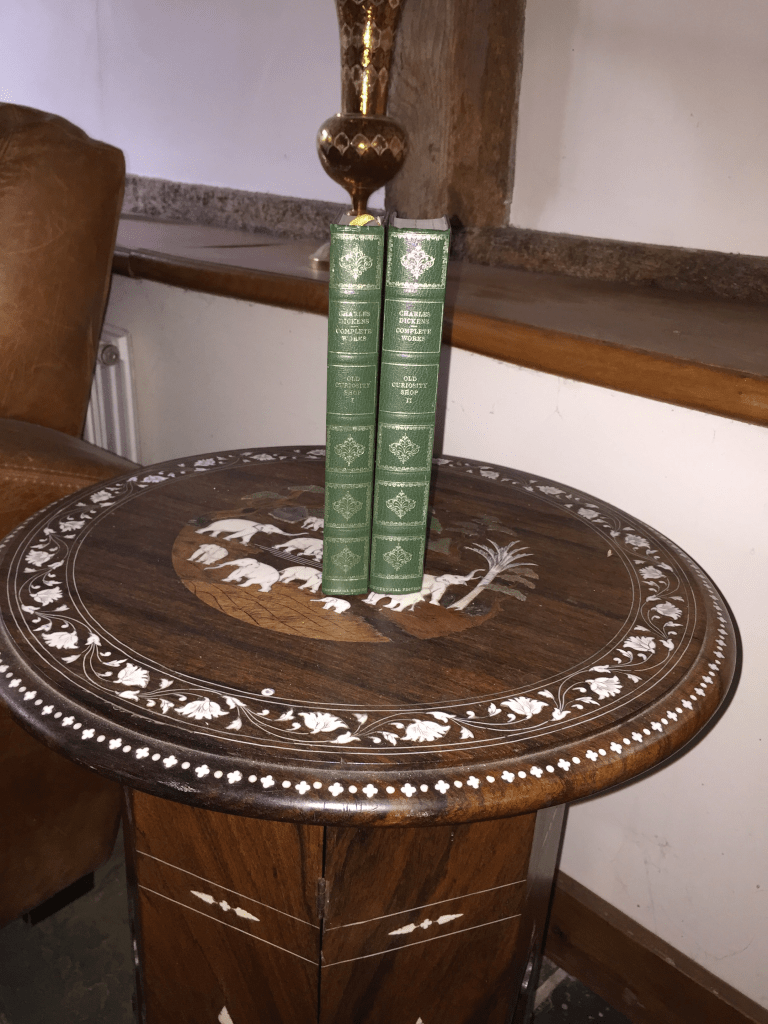
This book is blimmin’ long. My Centennial Edition experience was split into two volumes, both nearly half a thousand pages each including your introduction’s pontification in vol’ one and a smattering of appendices. Of course, Dickens WAS being paid by the word and initially made it as a serial for a bungling magazine, so I can understand why he’d plonk out this great mass of text to keep contemporary readers happy. Mind you, this does make getting through the whole piece rather laborious and definitely draining.
Fortunately, dickens is VERY thorough with heading his chapter – in fact, this edition has the decency to title the happenings of each page spread! This, I wish people carried over today – it makes finding your page much easier if you don’t can’t hack numeracy, as well as briefly summarising the section you’re reading.
“Just tell us what you think about the bloody writing, not the graphic! Screw presentation!”
Right! I would say this isn’t dickens at his most adventurous – you don’t get many “phonemickaly spelt ag-sents”, nor nifty jumps in style aside from a unprovoking switch in grammatical perspective at the start. You do, however, get plenty of worldbuilding fluff. For example, you have Kitt enjoying a holiday with his family, with vivid descriptions of oysters and shows that thankfully just averts Tolstoy level density. You witness a rather raucuous dinner party held by Betsy Quilp’s ailing mother which tries to convince the poor woman to leave the epitomised jerk with righteous severity. Now, some people might find these asides wearying, as I do, but it adds excellent depth to the lives of the characters. As tenuous as all this inaction might be, it revels in the quirks of each character involved and reveals so much more about setting: it creates a lively image of a different time, where oysters were cheap and the streets were a horse’s lavatory. I dare say it’s a good exercise to read when thinking about writing – thus the excessive academic focus Dickens recieves.
Now, as for characters, we might as well discuss a possible point of contention. You’ll like Dick, in the end. You might like Mrs Jarvis and her freaky ass entertainment. You may also take interest in the upcoming mention…but you might think the titular Nelly is a bit… silly.
Little Nell is described on terms of absolute perfection – she is the paragon of purity and piety. Characters fulminate about her innocent appearance and gentle ways until it exceeds saccharine – her grandfather breaks down into archaic tongue addressing her prospects for the future. It all gets a bit much, y’know? The actual character itself isn’t too unbearable. Her overly dainty nature could be excused on being raised by an elderly man and it’s not like she’s peelingly subservient, given that she’s downright fighting to protect her ailing elder from everything, especially in the wake of a stroke and earns her own living for a while. However, she is quite the vanilla protagonist: everyone else is written to be more interesting, with her being simply a vessel to explore the other characters. In the end, her only defining feature is that she abruptly dies and devastates everyone.
So, how did I take Nelly’s passing? Well, as soppy as the prose was in the final scene – “No sleep so beautiful and calm et cetera” – I was immensely aggrieved…not from sadness, but disappointment. By this point, things were looking up for the escapees of london; without going into details, they’d successfully evaded quilp and were hiding somewhere pleasant for a change, but then Charlie Dickenshead just strikes her down out of blinkin’ nowhere! Sudden deaths are, in many ways, quite realistic and thus more likely to tug at your heart strings, but come on – where was the buildup to this? Her previous spell of illness, coming from overwork, predates this fatal decline by nearly a season. The situation, combined with the purple accompaminent, was just a bit absurd. However, I felt really sorry for the aftermath, especially for all those present – three characters in particular, not least the grieving grandfather, get hit hard by this loss and it really hurts to see them torn up like this. I didn’t shed tears, but I did sympathise more with the poor sods than I’ve done for characters in a long time.
However, there is a character I want you to look out for.
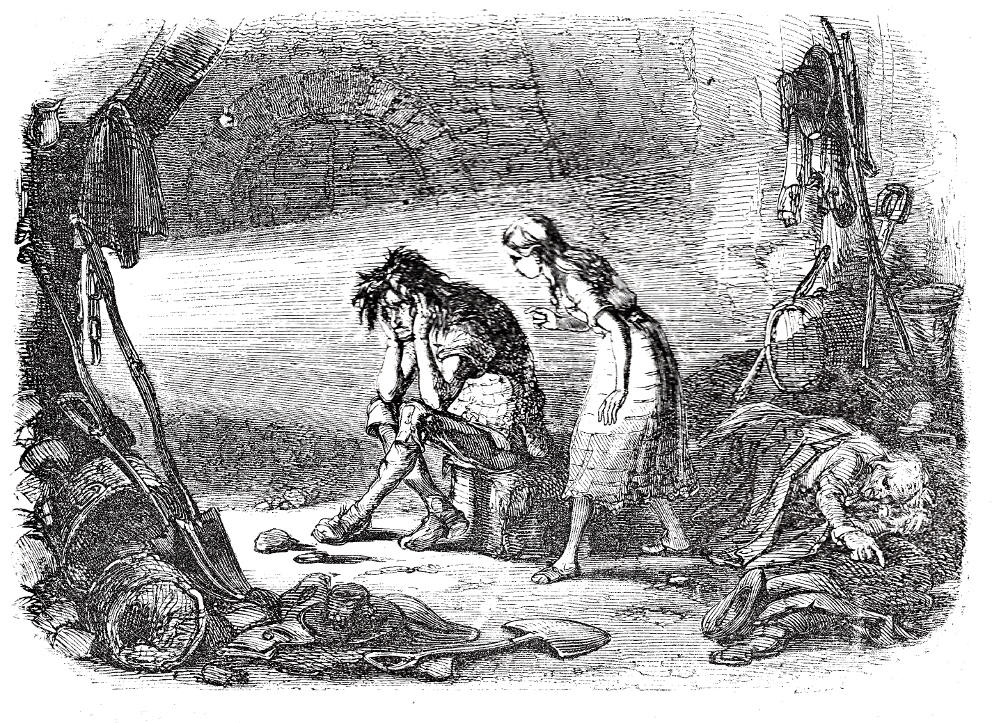
Around Chapter 43/44, Little Nell ends up in a townscape ravaged by overindustrialisation, poverty and riots. Wandering late, they eventually come across a ghostly, gaunt figure who invites them to stay in his workhouse. Despite the continuous racket of hammers (even late into the night) and the uncomfortable bedding, they oblige.
(Courtesy of victorian Web)
Waking later into the night, Nell strikes up conversation with their companion, who is staring intently into the maw of a furnace. He reveals himself to be an orphan, effectively raised by the sweatshop itself. He is effectively a generation raised by the misery of the industrial revolution – he has never seen the furnace go out in his entire life and feels a powerful familiar connection with the flames, which he claims to hold conversation with. He does not otherwise have any friends among his joyless human peers who mock him and certainly not the ruthless employers. He isn’t even given a name by the narrator, for he scarcely considers himself anything more than an automaton forged within this abominable machine, who is his true mother.
How metal is that?
I am surprised no-one else picks up on this. Like the derelict Mrs Havisham in Great expectations,the enigmatic ghost of Marley and even the bizarre absent Mrs Harris of (the less popular) Martin Chuzzlewit, here is dickens offering us a profoundly unsettling character in such vivid terms. This man only appears for real in two chapters, but he struck me as one of the most memorable characters in the whole piece – a poor wraith misraised by an overambitious world. It’s a touching reflection, really, of how technological development can ruin or distort people – I wish more novellists would focus on this!
Conclusion – not underrated, but still overlooked
In conclusion, curiosity shop is weaker dickens overall. There are many books which are shorter and punchier, delivering the same quality of characters and a much better plot in less waffle. It holds water a lot less well in the modern age than many other novels, as rapturously popular it was back in the day. However, I think it’s worth gleaning over if you’ve got free time – it’s very informative to examine the writer’s less than stellar production to see how it holds up against his best. Successful writers don’t always produce perfection – sometimes they settle with mediocrity and missed opportunities.
What’s your favourite Dickens novel? If you hate Dickens – please, tell me to bugger off and review something more interesting in the comments!
May you sleep better (but not as deeply) as Nelly’s corpse tonight!
 Ben Easton - The Novel Hovel
Leave a comment