Before I start this review, an acknowledgement – special thanks to my brother for spotting this in a store on his way back from a D&D game! Because of him, I didn’t have to pay £20 for this absolute whopper of a writing guide! Also, I acknowledge the fact that this has been posted a day later than I said it would. Sorry.
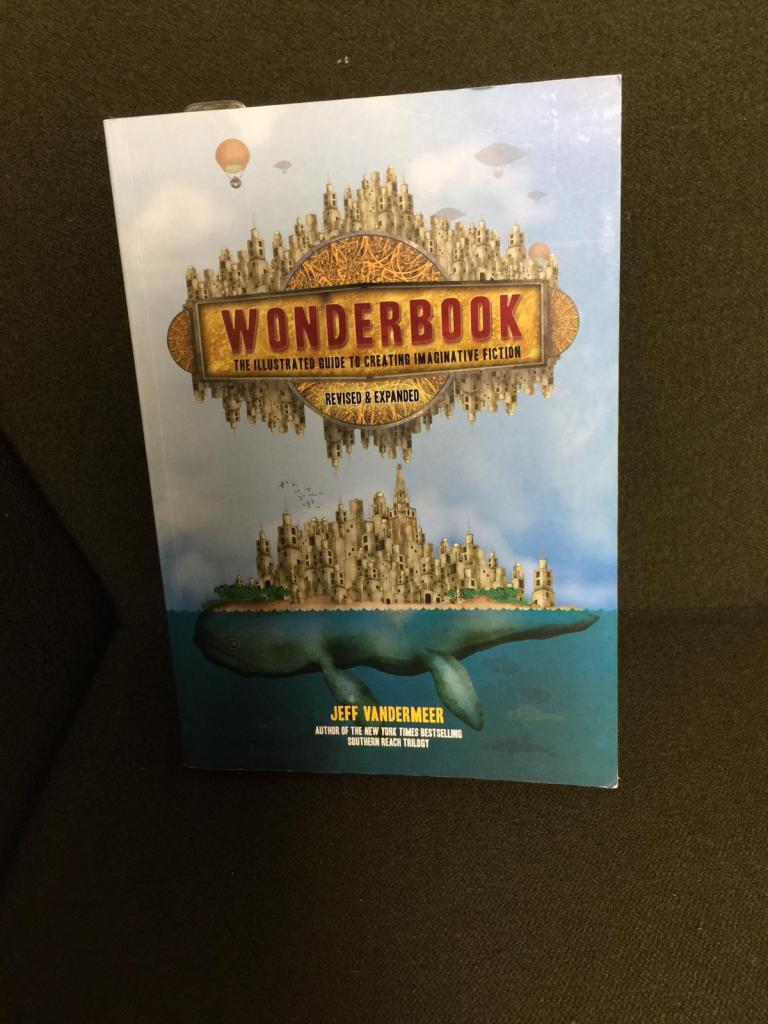
My only regret is that I didn’t have the time to portray this review in a dynamic manner.
Most books about imagination are, frankly, not presented as such. They might use fancy wordplay at best or maybe have a neat illustration on the cover or even the inside, but typically they are bare minimum guides: walls of text within rigid chapters. This, if you’re a real visual learner and very pedantic, might seem like a complete violation of common sense – how dare the literary masses sacrifice creativity of presentation for clarity’s sake!
If you want a visually imaginative take on imaginative exercise, good lord, is this book your oyster.
Stretching the limits of literacy
Jeff Vandermere and a pack of illustrators have gone wild in turning each free corner of this book into a vibrant masterwork. For every paragraph, there is a diagram brimming with enough sybolic vigour to bring tears to the eyes of Umberto eco and Dante Alighieri – even beyond the grave! Jeff has a thing for turning complex storylines and writing conventions into fish, robots or robotic fish. This is certainly something other writers are not doing.
But it is so much more than quirky pictures – the writing itself is extremely diverse! Half of the time, it’s written by Vandermere himself – bringing up bizarre anecdotes that inspired areas of his novels and doing very bizarre things with some of the exercises suggested (talking penguins being another recurrence). However, frequently interposed into the work are creative essays by other writers interviewed on the “green pages” – while a few are straightforward, formal breakdowns of how the narrator does their thing, others are presented in really wacky ways: Hand drawn with doodles, bullet pointed with self-demonstrating techniques, et cetera and beyond! You never know what the guests are going to pull next – you might be underwhelmed oftentimes, but as Vandermere says: “Curiosity comes from a willingness to be disappointed” (pg 13), and that same curiosity is what you need to play with to make new things.
Of course, Jeffy here wants to take the book to the next level with reader interaction. Unlike most advice books, the wonderbook is INTENSE. The writer tells you from the start that the best experience for the book is to read it all the way through and ponder all of oddities the characters on the margins offer. Yes, characters. There are six different guides who pop up about the text and all fulfill different educational roles – some offer bizarre viewpoints, others argue for tactics that oppose the ones the writer suggests and one simply reminds you that there are more resources on the online website. Yes, there is a website with more prompts and challenges, of which the book already has six standout brainteasers. In short, you are not in short supply of guidance.
All this, however, can seem a bit overwhelming to some readers. There is only 360 odd pages in all (less than those Gillray books I suggested last time) but it is seriously dense to read. It will take you nearly a week to get through it, especially if you’re doing all of the prompts and making notes. But this discomfort is a whetstone – it hones and stimulates the imagination like no other! Looking back on my earlier advice posts on this blog after reading this book, I’m shocked by how dreary my mind was before this readathon. It was like those before-and-after workout photo experiences: this book mentally changed me in a way like none other has.
I’m actually straining to think of criticism for it: maybe it’s not a read for a busy life? Even it’s length feels optimal – it doesn’t skip out on bitesize summaries, but it’s harder to visualise the same clarity of explanation in any less. Of course, some other guides have been higher rated overall on stuff like Goodreads – Jessica Brody’s “Save the cat!” guide to beat-sheets got an average rating of 4.5 out of a body of 6,954 opinions compared to wonderbook’s 4.34 out of 3,472. But blast that – you won’t find a guide as open or as engaging as Vandermeer’s opus in many bookstores!
Don’t be pedantic – test yourself and give this a read if you want to write unique fiction. Read this if you want to have a shot at saliency, at standing out from the conventional crowd! But remember – imagination comes from within you. This is only a key, albeit a very efficient one, for releasing it.
The 2018 revised edition of Jeff Vandermeer’s “Wonderbook – the illustrated guide to creating imaginitive fiction” is £19.99 ($24.23 USD) on waterstones. The website, free, is available at https://wonderbooknow.com/
 Ben Easton - The Novel Hovel
Leave a comment