
If this review were to be depicted as a suitable caricature, it would probably look like this:
The behaloed corpse of James Gillray is sitting upright upon his recently erected headstone at picaddilly with bug eyed delight about his mug. Before him, two figures are wrestling to present him with their hardbinded Paeons. A wide smiling, dark-haired young woman swats an older,grimacing intellectual with motorboard and all with an oversized samsung labelled “The tick-tock device) while an assembled camera crew of mischevious cameramen indiscriminantly egg both sides on with waterstones coupons. The man is sagging under the weight of a huge, radiant tome faced with the oversized rump of William Pitt’s horse whereas the woman waves a tiny, punchy looking book in her free hand. Behind them is a large and diverse crowd – some among them are distraught victorians and edwardians, fainting and crying “traitor! Zombie! O hell!” On the other hand, there are georgians among them, including Gillrays Caricaturist peers Thomas Rowlandson and Isaac cruikshank, roaring with laughter. Gillray himself has something to say, and that is “Damme, look at those viccies fly! Aye! Aye, I’m resurrected with all the trimmings! Well done all! well done!
Oh, alright, I’m not great at caricature design. Gillray could do better of course, but you get the gyst. The woman is Alice Loxton – Tv historian and educational influencer whose brought a little culture to the glurge of Tiktok. Wanting to make the epic satire of the regency cartoonists available to a more general readership, she published the very light, funny and ultimately low expense (Got it for £17 quid) biography collection. The man, on the other hand, is Tim Clayton. A more thorough, focused historian of the eighteenth century and antique consultant, he compiled an immense catalogue of colour caricatures by Gillray in particular, producing a heftier and admittedly more academic account of the great artist’s life.Despite sharing a focal time period and at least one joint subject, these books are very different from eachother beyond the obvious size disrepency. In the imaginary wrestling match depicted in the caricature, let’s see who wins the belt for securing Gillray’s name!
Punch, puns and Parliament – UPROAR!
UPROAR! is a what I’d call a great gateway read into the world of caricature artists. It tells you the rough overview of what you ougt to know, in words plain and clear, stoking your appetite just enough to want to do some wider and trickier research. Mind you, it’s so much more than just that.
Though Alex Loxton’s book is hardly brief at nearly 400 pages long (including the very generous glossary and bibliography), it doesn’t outstay it’s welcome. It tells you just enough about every topic raised in biography’s fifteen chapters but never outpaces one’s appetite. Although Gillray understandably hogs the spotlight once he kicks off his most outrageous prints, you will still get to hear plenty about Tom Rowlandson and Isaac Cruikshank, not to mention other lesser stars of the industry. There’s even time for an overview of the printing process, which Loxton took a class for, and even the possible origins of the modern caricature among Bosch, da Vinci and Archimboldo!
Alice Loxton understands that a book about caricatures needs to be…You know, funny? Hot damnity, she delivers! Worked into the vivid prosaic descriptions of georgian life in all scatalogical glory, she’s tying it back to the present with welcome references to modern pop culture. For example, early on she describes how Thomas Rowlandson, studying as a young aspirant to art at the snooty-fresh Royal academy, landed a year of experience in pre-revolutionary paris under the tutorage of the famous Jean-Baptiste Pigalle. This surge of fortune, according to a cheeky Loxton, is like going from a “Chance to get a five minute interview on The One Show” (royal academy) to “The equivalent of being sent to Hollywood” (Pigalle). I do not watch live television of any kind, but this early reference was not lost on me, nor were the numerous Harry Potter jokes – another franchise I haven’t chosen to endorse. Fear not, non-brits: there’s something to laugh at for you!
But don’t think a novel about culture is all low-brow jokes and swearing – arguably, Loxton’s repertoire is cleaner than Clayton. The vigorous wordplay about the caricature summaries and episodes of the biography is a recurrent joy, with silly endearments for the political figures and bizarre metaphors being thrown into the broiling pot. But the book knows when to swap it’s tone. Many passages, towards the end of the book, bring out the descending hungover gloom of the dwindling regency – as the merry trio wane and sputter, the sentimental, moralist misery of the victorian era slowly seeps in as privation to the merriment. This same social shift, Loxton notes, would later villify and obscure the printing bawds of the past, thus relocating their excellent pieces to be overlooked for years. I mean, not even regency based media like Bridgerton or The madness of King George give them any credit for the merciless damage they did to the royals! Rightfully, Alice Loxton wants to reverse this by cracking all the best jokes from these old prints to the modern world to hopefully revive some interest in this underrated aspect of georgian life.
Overall, I’d say my criticisms are either subjective or can be easily excused. There’s no colour pictures inside to save on price, there’s not a huge array of caricatures for people beyond Gillray because most were lost during the victorian tumult, there’s no advanced analysis into symbolism to keep it accessible. The only real problem I might see a reader having is with Loxton’s silly, smug style…but why would you even buy a book presented like this if you didn’t want a comedian?
belt for securing Gillray’s name!
Gillray under the spotlight – A revolution in Satire
If you’re looking for something a lot more substantial and have a heck of a lot more money to burn, there’s Timothy Clayton’s absolute goliath of a biography on Gillray. Believe it or not, it’s ALSO exactly 400 pages long like Loxton’s book, though the bibliography is a bit smaller by proportion, so there’s technically more actually worth reading including prodigious notes! Mind you, that doesn’t sound the most appealing, does it?
Do not be daunted by the size of the pages – most of the text is broken up by extremely high quality colour illustrations of the caricature artists best works and inspirations, fit with extensive descriptions of the contents.Clayton has put as many surviving prints of Gillrays as he can under intense scrutiny; he describes extensively all the subtle details and classical references in his piece all the way down to alternate interpretations and injokes. He makes an effort to trace the originator of each piece, providing insight into Gillray’s commission process and allies as well as the printing itself. He also has time to touch on many anecdotes Loxton has not, such as the time he savaged a pretentious Shakespeare exhibition by the snooty Boydell family and even allegedly helped create a fraud saxon tablet as part of a prank!
Mind you, the style is a bit less lovable than Loxton’s. It’s not like it’s totally stoic academia – Tim drops a couple of scatalogical expletives and talks about phallic imagery a lot more than Loxton dares to in her accessible book. A fair warning that this work contains 2 pieces of outright SMUTITTY by Gillray – I’d skip pages 91 and 205 if you’re a complete prude like me or just don’t want to be caught at a bad time! There is certainly a more serious tone than the chattiness of UPROAR(!), which allows it to provide a higher density of information at the cost of not having any extra assistance with processing it. The chapters are arguably shorter than Loxton’s though, so you won’t get absolutely gut-sick of any rambling.
Again, there are still drawbacks to this book. This is purely a tome for feeding an artistic mind – hardly any jokes about it at all for you to chuckle at and not the same emotional depth as the little sister. If you’re not into essays, you better hope the funny Gillray pictures will carry you through. Also, there’s no denying that FIFTY QUID is quite a steep price unless you hope to resell it some day for even higher once it becomes a collectors item. Unfortunately for me, I’ve made a right dog-ear of the cover, so I’ve reduced it’s value to piecemeal! It’s too late to mourn for me…
Conclusion – What the hell does this have to do with Aliens?!
Ultimately, if I was going to pick a book I’d recommend of the two, particularly for the long dead artist inspiration, I’d choose Loxton’s cheap and cheerful over Timmy’s glorious yet serious whopper – it’s a book worth reading, rather than just gleaning the pictures for the substantial humour. If you fancy a break from reading novels or want to research the setting for your Jane Austen parody (e.g.Northanger Abbey WITH TIME MACHINES!!), it’s an immensely entertaining way in. Loxton gets the belt!
Do you have any art portfolios or exceptional biographies to recommend? Let me know (or not!) in the comments.
An afterword (don’t read if you can’t be arsed)
Now, I know, as a writer on wordpress, you’d expect me to review a relevant novel (particularly sci-fi) for my first book review. Weel…you’re right to think that, but as an artist as well, I look for stimuli in unusual sources. Besides, there’s plenty of science fiction novels inspired by Anime or contemporary political events – why not draw freaky alien designs from political cartoons? Well, just to end this rambling review, I’ve got a little design worth showing:
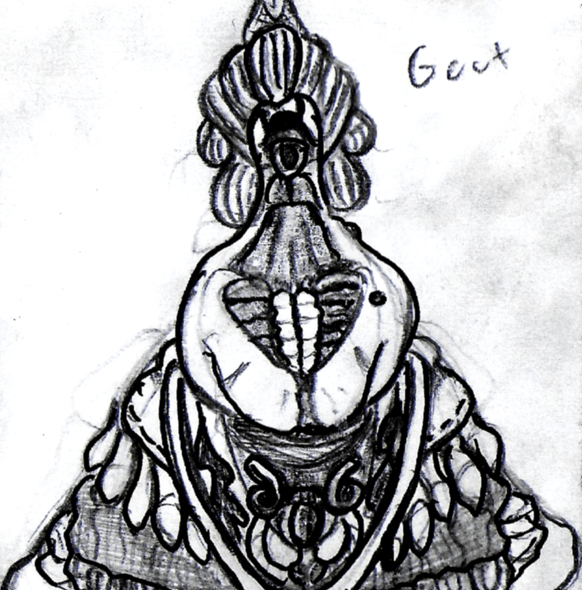
Bit of a shoddy sketch, but this here is an alien I’ve DEVOTED to james Gillray – the Gout. They’re not a major race in my novel as of yet, being rather a terrestrial-level advanced civilisation from the wider galaxy, but I decided we needed less lazy animal-hybrid designs in my setting. Fun fact – the famous movie design of the Vogons from Douglas Adams “Hitchhiker’s guide” were also inspired by the grotesque Tarrares of Gillray’s works – testaments of how far the mortal skin could stretch!
 Ben Easton - The Novel Hovel
Leave a comment