Good morning!
Well, since I’ve already done today’s daily writing prompt last thursday, I can finally spend my time writing something relevant again! For those rightfully concerned about my sanity, I’ll only be doing those prompts for another week at most to keep me in the swing of writing on a daily basis. But enough of that tripe.
It’s time to get back to the advice!
Making a plot to fit a protagonist or vice versa.
It is actually impossible to make a story without a protagonist or a plot, so you’re probably not missing any of these when you first come up with an idea for a story. But what are either of them, really? As intellectuals do, there is much debate over whose precise definition is correct and deserves the most accolades for it, but to put it in my own words:
Plot is the chain of events that your story is driven on.
A protagonist is the sole or shared main character of the story, regardless of morality, likeability or even POV. They are the most effected by the plot.
These two factors are, thank god, mostly intangible. If you develop one, you will likely do something towards the other – it’s not a 100% rate of conversion however, so you will need to jump between refining both as the story progresses. Fortunately, once you get into the swing of writing novels, characters and plot will develop themselves as you write the main body of text, as your brain will subconsciously manufacture and remember most of the necessary maintenance details, but it is always good to divulge in a little pre-planning of both before you begin. You might be noticing a trend here – ground work always pays off, even if not quite in ways you’d expect. The more practise, the closer you come to perfection!
With this in mind, you can begin preparing your story by choosing one of the duo, preferrably the one that comes the easiest to get you suitably motivated. Since it’s my speciality, I’ll demonstrate how character motivation can be used to kick-start your plot.
Plot’s Designated driver
Your protagonist’s desires are the reason the plot exists – they want to achieve something within the setting that will ultimately favour them or someone/something they care about in some way. Without stakes, I’m sorry to say, you’ve got nothing worth reading. If we’re going down this character focused form of story planning, we will need to start with this protagonist motivation before we create supporting characters to, well, support it and antagonists to oppose/compete directly with it. But how do we figure out your little star’s motivation if we don’t fully know who they are? This is where character profiling comes in…
Many bad character designs could’ve benefited from some thorough notation and your protagonist (no offense) is hardly an exception. Character profiles can take many different forms – they can just be a series of lists or some elabourate planning tool, but they need to be accessible and legible, or else you’ve just got a sorry mess! You will record whatever helps you write them here and use it to keep them consistent. Your first profile, arguably, should be the character you initially envision as your protagonist – their role may be subject to change as you draft and redraft your project.
Course, you’ll be needing something useful to put in your protagonist profile to start with, but I’ve got just the ticket – a starter questionnaire!
Courtesy of Curtis Brown creative for introducing me to this idea in a course they ran. Interrogating your ideas is absolutely vital for evaluating and expanding them, so forcing yourself to complete a thorough questionnaire on them is a good way to flesh them out before you consider motivations – it’s often a fun way to spend a rainy weekend, at least for me. The more questions you ask yourself, the more you realise what you want to do with your protagonist. Of course, it’s a real palava to actually think of the questions all by yourself, so it’s good to use a template…
Well, I’ve got a present for you! A character questionnaire of my own!
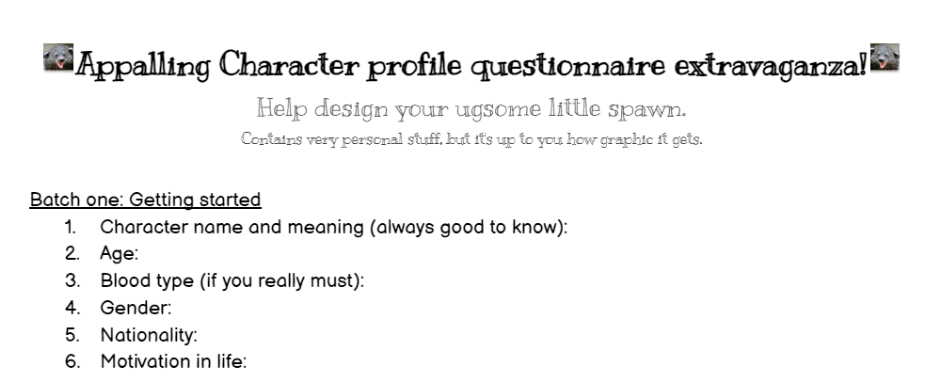
Ta-dah!
That’s right! I made a little PDF for all of you at home. Think of it as a little birthday present from me – you can apply it to any of your characters as you see fit to jog your mind!
With these qualities of your protagonist lain bare, you’ll begin to get round to understanding what makes them tick. You’ll know what they want, how they’re inclined to get what they want, how they interact with other character types and so on – this will help you form the motivation. Then, from this motivation, you can create obstacles to center the plot around.
Let’s use the most riveting, iconic protagonist of all to demonstrate this:
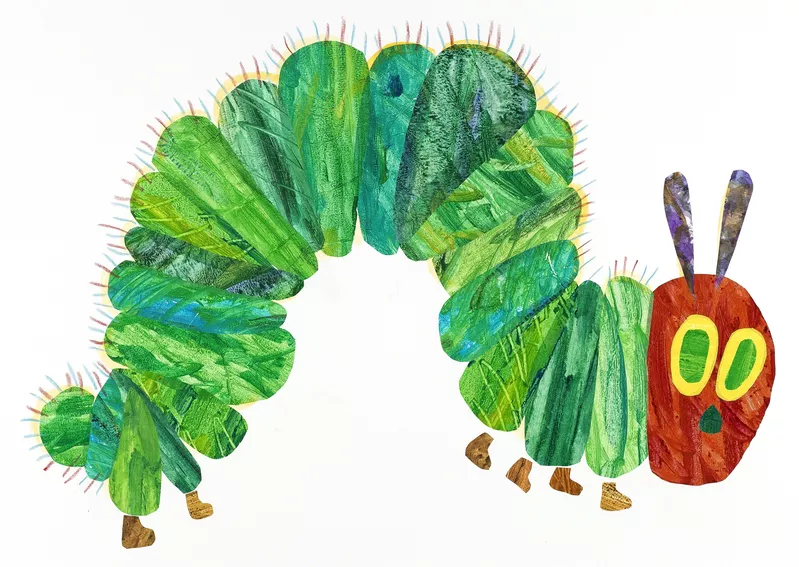
The very hungry caterpillar’s motivation is gluttony – in order to become a butterfly, he must accrue the necessary energy to ascend. In order to get this energy, he must eat. Thus, we have a basis for other characters/obstacles: the food. The apple, the pears, the cheese-and-icecream-and-muffins! They are all created to sait or challenge the protagonist: The antagonistic junk food gives him chronic Dyspepsia, yet the noble leaf soothes his troubled gut. We’ll look more into it later, but all these obstacles set the basic groundwork for a narrative arc – the rising action comprises his escalating hunger, the climax comes from his stomach ache, the falling action/catharsis is the medical leaf and the resolution is his pupation into a beautiful butterthing. You get the gyst?
Thus, in the same way, you can begin to outline your own story from a motivation. You may consider the obstacles that may stop your character from reaching their motivation’s apex, generating more from cause and effect – caterpillar is still hungry after one apple, so he goes for 2 pears etc. Who cares if the character isn’t relatable enough at this stage or if the plot is barebones! You have somewhere to begin, some places to go, just from the unfolding of your protagonist.
————————————————————–
Anyhoo, advice for creating good characters and detailed plots will come in time – for now, use this exercise to get into practise. Has this advice been helpful or could it be improved? Provide some criticism in the comments or I’ll just stagnate forever. If you find my stagnation amusing, then don’t say anything. I’ll be here all week, either way!
Have a good weekend for me!
(Edit – forgot to add the bloody tags again! This should help you find it!)
 Ben Easton - The Novel Hovel
Leave a comment